
introduction to VMware Cloud Foundation
Exploring practical insights
expertise
If you know VMware technology then you’ll recognise its pivotal role in advancing virtualisation and being a building block for the cloud.
Over 20 years ago VMware started with virtualising physical servers and has progressively added more and more products and cloud solutions to their portfolio including virtual desktops, storage, networking, security, automation, management and, most recently, application containerisation.
Combining these components enables comprehensive platforms to be built. However, this can also increase the complexity organisations face in designing and delivering their own cloud model.

Q1 : What is VMware Cloud Foundation?
Q2: What challenges does VMware Cloud Foundation address?
Q3: What are the key use cases and drivers?
Q4 : What are the deployment options?
Q5: What is the entry level deployment size and how far does it scale?
Q6: What capabilities does VMware Cloud Foundation contain?
Q7: How are licenses managed in VMware Cloud Foundation?
Q8: What hardware can it run on?
Q9: Does it integrate with existing VMware deployments?
Q10: Is transitioning to VMware Cloud Foundation 9.0 easy?

Introduction: Your guide to VMware Cloud Foundation
The private cloud market is experiencing unprecedented growth, driven by organisations seeking greater control over their data, enhanced security, and the flexibility to innovate whilst managing costs effectively. As businesses navigate increasingly complex regulatory landscapes and the demand for AI-ready infrastructure accelerates, many are evaluating private cloud solutions to ensure they maintain competitive advantage in the future.
Since Broadcom’s acquisition of VMware, the company has pledged to invest $2 billion annually into VMware products and services, cementing VMware Cloud Foundation (VCF) as the market-leading private cloud platform. This investment underscores Broadcom’s vision of VCF as a flagship solution – one that is future-ready and purpose-built to meet the challenges facing modern enterprises.
Industry recognition validates this leadership position, with Gartner naming Broadcom (VMware) as a Leader in the 2025 GartnerⓇ Magic Quadrant for Distributed Hybrid Infrastructure for the third consecutive year.
Why Xtravirt
Navigating the transition to private cloud requires more than just technology – it demands expertise, experience, and a partner who understands your unique business challenges and goals. Xtravirt brings deep technical knowledge and proven deployment experience with VMware solutions, positioning us to answer your critical questions with confidence and clarity.
As a leading Broadcom Partner, we bridge the gap between technology and business outcomes. We help you evaluate VCF not just as a product, but as a strategic platform that can transform your infrastructure, accelerate innovation, and deliver measurable return on investment.
question one
What is VMware Cloud Foundation?
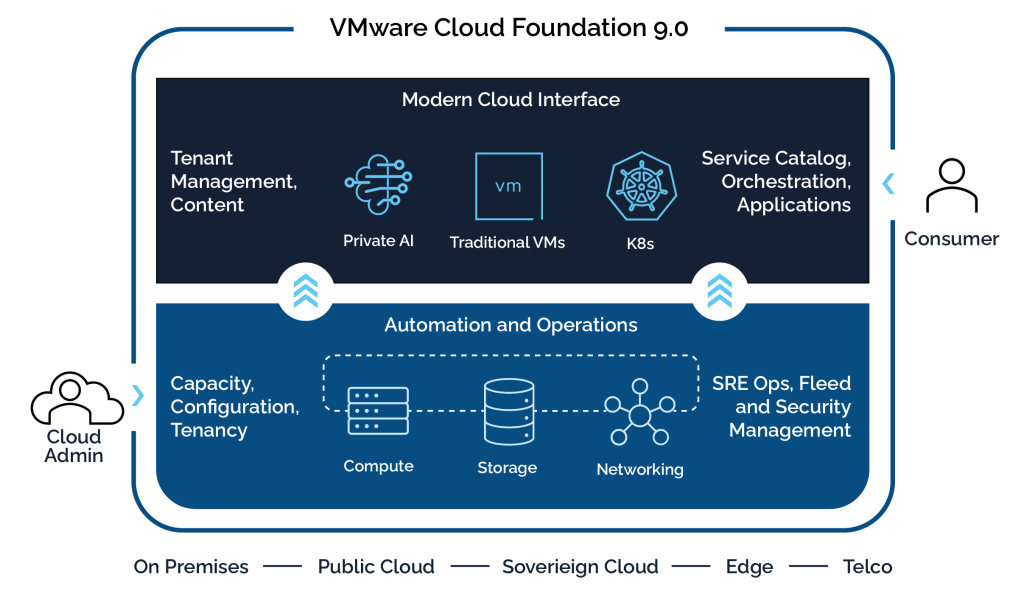
VMware Cloud Foundation is a unified private cloud platform that eliminates the operational complexity of managing separate infrastructure silos. Rather than juggling distinct tools for compute, storage, networking, security, and automation, VCF delivers a single management interface across the entire suite of products that make up VCF (vSphere, NSX, VCF Operations and VCF Automation).
For organisations running traditional vSphere environments, VCF provides a standardised migration path to modern cloud capabilities without rearchitecting from scratch. The platform adds enterprise storage, software-defined networking, integrated security, and self-service automation to your existing VMware investment, allowing for agile development whilst maintaining the governance required by your organisation.
VCF is also architected for hybrid cloud from day one. The same operational model extends to public cloud services, enabling consistent policy, security, and management across on-premises and cloud footprints.
question two
What challenges does VMware Cloud Foundation address?
access to modern cloud in a standardised but flexible way
- Off-the-shelf: VCF removes the complexity of mix and match design with a certified pre-defined architecture, reducing transformation time, cost and risk. A combination of capabilities all designed to work together and each being independently recognised as best in class technology.
- Logical upgrade path: For organisations who have previously invested in VMware technology, VCF enables an upgrade path from traditional VMware vSphere solutions to a modern private cloud platform unlocking new advanced capabilities while able to retain and build on the same existing operating skills.
- Modular and extensible: Being modular enables the platform to scale in size and location while also being the building block to extend into public clouds, all using the same management tools. It gives the ability to scale and progressively unlock more advanced features and capabilities as business needs evolve.
- Simplified maintenance: Broadcom certify the version interoperability and update path for every software component underpinned by lifecycle automation tools, resulting in the reduction of maintenance overhead and risk.
- Integrated security and compliance: Solutions are integrated throughout the platform, not just in selected components.
VCF 9.0 features a redesigned day zero experience with the new Cloud Foundation Installer. It supports both greenfield deployments and the ability to import and convert an existing vCenter appliance into a VCF deployment.
Enhanced TCO and performance
- VCF 9.0 achieves 34% lower storage Total Cost of Ownership (TCO) with the integration of Global Deduplication in vSAN ESA, which eliminates duplicate data across the cluster in real time.
- VCF 9.0 offers a 40% reduction in server TCO using Memory Tiering with NVMe. This innovation analyses memory page access rates, shifting “cold pages” to less expensive NVMe drives.
- VCF 9.0 provides 3x switching performance improvement due to kernel optimisation of the NSX enhanced data path, which helps achieve near line rate for packet processing.
- VCF retains nearly 99% of bare metal inference performance for ML benchmarks. It also introduces vMotion for AI capabilities, allowing for a live vMotion even for large AI/ML jobs running on vGPUs, ensuring a truly zero downtime environment.
AI/ML Workload Support: Private AI Foundation licensing is now included within the VCF licence allowing customers to more easily deploy AI/ML workloads.
Providing wider value to the organisation
Beyond VMware Cloud Foundation’s technological value there are many broader business benefits for key roles in organisations:
- Head of IT Ops: A well-integrated suite of products providing the IT team with consistent management tools, while simplifying training and knowledge management. Automation provides a platform for achieving operational efficiencies and process standardisation, providing self-service functionality to the wider business.
- CIO: An opportunity to achieve a wholescale infrastructure transformation program. By delivering mature private cloud functionality to in-house infrastructure and offering a managed gateway to integrate VMware and other hyperscaler cloud platforms, VCF supports a strategic roadmap based on incremental change and delivery.
- CFO: VCF consolidates licensing into a single subscription based on cores and storage, no more juggling multiple product keys. Built-in cost management provides transparent showback and chargeback, giving clear visibility into infrastructure spend by department or project. The consistent hybrid cloud model enables genuine TCO comparison between on-premises and cloud placement.
- CISO: VCF delivers unified security across VMs, containers, and hybrid environments from a single pane. The new SecOps Dashboard surfaces CVE exposure, certificate health, and authentication anomalies in real time. Built-in compliance monitoring continuously validates against CIS, NIST, PCI DSS, and DISA STIG benchmarks, with automated drift detection to catch configuration changes before they create risk.
- Internal Audit, Risk and Compliance: VCF reduces operational risk through simplified, centralised lifecycle management. All components can be validated and patched or upgraded through a single interface, helping eliminate potential version drift. Common tooling across private and hybrid cloud reduces key-person dependency and simplifies audit evidence collection. Automatic application discovery maps workload dependencies, and integrated troubleshooting correlates logs across compute, storage, and network layers. This enables faster root cause analysis without specialist skills.

question three
What are the key use cases and drivers?
Modernisation of the data centre with a consistent operating model across IT infrastructure to reduce silos, management overhead and costs
- Standardised and certified platform architecture: This enables simplified access to latest technologies for security, storage, networking, automation, self-service, and modern applications to reduce service delivery time. Ability to unlock new features as the organisation evolves provides flexibility and cost management.
- Stable operations and advanced management capabilities: This enables reduced operational overhead, and increased capability to expand complex services with less risk.
- Ongoing development of the platform: Broadcom continually enriches the capabilities while providing future proofing and ease of scalability at the same time.
- A common foundation: Deploy modern future-ready workforce solutions that take advantage of secure, scalable and automated capabilities of the platform.
- Hybrid cloud and workload mobility: HCX enables live workload migration between on-premises VCF and VMware-based clouds without downtime. Fleet management provides consistent operations, policy enforcement, and cost visibility across distributed VCF instances.
VMware Cloud Foundation extends to leading public cloud providers, enabling hybrid cloud operating models
- VMware Cloud: VMware Cloud Foundation underpins VMware-based services on major hyperscalers, including Amazon Elastic VMware Service (Amazon EVS) and Google Cloud VMware Engine (GCVE). This enables organisations to extend their on-premises VCF environment to public cloud infrastructure using familiar tools and operational processes.
- Path to application modernisation: VCF’s embedded vSphere Kubernetes Service (VKS) enables organisations to run VMs and containers side-by-side on a single platform. Development teams can modernise applications incrementally, containerising components as appropriate while maintaining existing VM-based workloads without requiring separate infrastructure stacks or operational models. GitOps integration with Argo CD supports infrastructure-as-code workflows for consistent, auditable deployments.
Enable application teams to move fast while IT maintains governance and control
- Consistent and compliant: VCF provides a unified platform where security, networking, and governance are built into the foundation. Application teams consume infrastructure through a standardised self-service interface while IT maintains policy control. Compliance monitoring validates infrastructure against industry benchmarks (CIS, NIST, PCI DSS, DISA STIG) out of the box, with configuration drift detection alerting on unauthorised changes.
- Automation: VCF 9.0 introduces native multi-tenancy, bringing capabilities previously only available in VMware Cloud Director into the core platform. VCF Automation creates isolated private clouds for different tenants or business units using Virtual Private Clouds (VPCs) that provide simplified network isolation in the same way as the public cloud. The platform automatically provisions the underlying network infrastructure, Transit Gateways, NAT, routing, behind the scenes. Application teams provision VMs or Kubernetes clusters in minutes through a modern cloud interface (UI, CLI, or Kubernetes API), with tenant-based chargeback and showback providing cost visibility per project or organisation. This delivers a public cloud-like self-service experience for developers while giving operations consistent governance and control.
- Simplified management: VCF 9.0 consolidates management from over a dozen consoles down to a single console each for operations and automation. This unified operational model enables application development infrastructure to be centrally managed across multiple VCF instances whether on-premises, at edge locations, or in VMware-based cloud environments with consistent policy enforcement and visibility across the fleet.


question four
What are the deployment options?
VMware Cloud Foundation can be deployed in several ways:
- Software on validated hardware: Purchase VCF software and deploy on hardware from the Broadcom Compatibility Guide. This provides maximum flexibility in hardware selection but requires more deployment expertise. The VCF Installer (new in VCF 9.0) simplifies deployment with guided workflows, reducing deployment time from weeks to hours.
- Converge existing vSphere environments: VCF 9.0 introduces streamlined pathways to convert existing vSphere 8.0 environments into VCF without migrating workloads. The VCF Installer can converge an existing vCenter deployment into a fully functioning VCF instance, enabling organisations to modernise in place, as long as the hardware is on the compatibility list.
- VMware-based cloud services: Consume VCF-powered infrastructure from hyperscale providers: Amazon Elastic VMware Service or Google Cloud VMware Engine. This provides VCF capabilities without hardware ownership, enabling burst capacity, disaster recovery, or hybrid cloud scenarios. VCF licence portability (for qualifying subscriptions) allows organisations to use their existing licences across on-premises and supported cloud environments.
Each option requires different skills and experience to deploy, configure and operate effectively, and to support this process Broadcom operates an accreditation program for VMware Cloud Foundation partners who can support customers through these transformations.

question five
What is the entry level deployment size and how far does it scale?
VCF 9.0 can start with as few as 2 ESXi hosts (using external NFS or FC storage) or 3 hosts with vSAN — with 4 hosts recommended for production resilience. Management components can deploy in Simple (single-node) mode for smaller environments or High Availability (three-node) mode for production.
VCF scales through workload domains and clusters, multiple VCF instances can be managed as a unified fleet, enabling deployments that meet enterprise-scale requirements.
Whatever the starting point, VMware Cloud Foundation can evolve and scale in line with Broadcom’s published product limitations and typically can meet the needs of the largest enterprises.
question six
What capabilities does VMware Cloud Foundation contain?
Core Virtualisation and Infrastructure
- vSphere: The core server virtualisation product that powers the platform’s capability to deploy and manage virtual machines and the surrounding central infrastructure that supports it. It includes VMware ESXi, the hypervisor which also contains standard virtual networking, and vCenter for centralised management.
- vSAN: Software that virtualises storage from one or more hardware storage devices, reducing silos, enabling flexible storage policies on a per VM basis. It is fully integrated into vSphere which together forms VMware’s Hyperconverged Infrastructure (HCI). VCF 9.0 achieves 34% lower storage TCO with the integration of Global Deduplication in vSAN ESA, which eliminates duplicate data across the cluster in real time.
- NSX: The key to facilitating the cloud operating model with self-service through software-defined networking, it is a complete networking and security virtualisation platform that manages Layer 2 to Layer 7. NSX makes it possible to assign and manage network resources independently of the underlying hardware. VCF 9.0 provides 3x switching performance improvement due to kernel optimisation of the NSX enhanced data path.
- VKS: Formerly Tanzu, fully integrated into the core platform, VKS delivers a certified Kubernetes runtime that runs natively on vSphere. This enables managed container orchestration with self-service provisioning, unified lifecycle management and enterprise grade security. This allows for new cloud-native services to be developed alongside existing workloads.
- Private AI Foundation with NVIDIA: A joint enterprise AI platform from Broadcom and NVIDIA enabling secure, on-premises RAG workflows, LLM fine-tuning, and inference. Built on VCF and NVIDIA AI Enterprise, it delivers 90% lower costs versus public cloud through vGPU resource sharing, integrated security, and streamlined deployment while maintaining data privacy and compliance.

Management and Operations
- VCF Operations Console : The landing spot and main console for private cloud operations and day-to-day activities. This shifts operations away from managing individual technologies and provides a unified interface for managing the entire platform.
- VCF Automation: A separate single interface for all automation, enabling setting up VM services or container services in minutes as the platform curates the automation flow.
Security and Compliance
- Security Operations Dashboard: Provides a quick view of open CVEs and authentication failures.
- Configuration Compliance and Monitoring: Tracks deviations from desired standards and can generate alerts or tickets if unauthorised configuration changes occur.
Troubleshooting and Insights
- Application Insights and Troubleshooting: Provides full application mapping, helping IT staff quickly narrow down the time window and location of issues without requiring deep expertise across storage or networking.
- Centralised logging: Provides a powerful logging platform to assist in troubleshooting and make it easier to perform root cause analysis.
question seven
How are licenses managed in VMware Cloud Foundation?
Licence management is now simplified via the Broadcom support portal or the new Business Services Console at vcf.broadcom.com. This console enables customers to:
- View licences
- View allocated/used capacities
- Manage subscriptions and history
- Split and merge allocations into separate licences, such as carving out cores for a development environment
Licensing for systems not connected to the internet can be managed by uploading usage information to the console and downloading the resulting licence file.

question eight
What hardware can it run on?
The platform can run on certified server, storage and networking hardware configurations from many of the leading providers including Dell, Fujitsu, Hitachi, Cisco, HPE, Lenovo and QCT. This enables organisations to benefit from existing hardware supplier relationships while retaining the flexibility to deploy and configure VMware Cloud Foundation themselves.
When running on premises and using vSAN, the general recommendation is to select vSAN Ready Nodes from your hardware provider of choice and then work with a trusted partner to size them appropriately for your workloads.

question nine
Does it integrate with existing VMware deployments?
VMware Cloud Foundation is designed to co-exist and integrate with existing or legacy VMware environments. It also has functionality built in to simplify the migration process from those environments, typically reducing the cost of deployment and transition.
VCF 9.0’s redesigned day zero experience with the new Cloud Foundation Installer supports both greenfield deployments and the ability to import and convert an existing vCenter appliance into a VCF deployment, making the transition seamless for organisations with existing VMware infrastructure.

question ten
Is transitioning to VMware Cloud Foundation 9.0 easy?
The transition to VCF 9.0 is designed to be a non-disruptive evolution, transforming disparate components into a single, unified private cloud platform. Depending on your current environment, your path to VCF 9.0 will fall into one of the following three categories:
- Modernising Standalone vSphere (The Convergence Path): For organisations currently running standalone vSphere 8.x, VCF 9.0 offers a “modernise-in-place” option. Using the new VCF Installer, you can converge your existing vCenter and hardware into a fully integrated VCF management domain without the need to migrate workloads. This path is ideal for those looking to transform loosely coupled infrastructure into a tightly integrated fleet with unified automation and operations.
- Evolving Existing VCF 5.x Footprints (The Sequential/Skip-Level Path): Customers already running VCF 5.0 or above can transition to VCF 9.0 via either a sequential or a skip-level upgrade. The experience is defined by your current management tools:
- Orchestrated Transitions: If using the Aria Suite Lifecycle Manager, the process is highly automated, orchestrating the upgrade of the entire operations and automation stack simultaneously with the core infrastructure.
- Direct Component Updates: For standalone environments, the transition involves updating core components like SDDC Manager first, which then facilitates the upgrade of the remaining stack.
- Upgrading Legacy VCF 4.x Environments (The Two-Step Path): Organisations running legacy VCF 4.x deployments follow a staged transition. This requires an interim upgrade to VCF 5.2 before moving to the VCF 9.0 platform. This ensures all environmental, software, and hardware prerequisites are met to support the unified architecture of version 9.0.
It is important to be aware that during the VCF 9.0 transition, there is currently no supported upgrade path for environments managed by VxRail. Additionally vCenter servers configured in enhanced link mode must be removed from that mode prior to starting the upgrade.
Xtravirt is the UK’s leading private cloud services company specialising in VMware Cloud Foundation. As a top tier Broadcom Partner with a long history of expertise in VMware technologies we are uniquely positioned to strategise, deliver and manage VMware Cloud Foundation aligned to your target business outcomes.
Talk to us about:
- VMware Cloud Foundation readiness assessment
- Private cloud operational maturity assessment
- Future value realisation mapping
- Competitive Total Cost of Ownership analysis
For more information go to: xtravirt.com/VCF

